


Category Archives: SaaS
Automating SaaS Support for Better User Retention
Source:https://mouseflow.com
It is 2:00 AM on a Tuesday. Imagine a user trying to export an invoice from your SaaS platform, but the system throws an obscure error code. Frustrated, they click your “Help” button, only to be met with a cold form that promises a response within 24 to 48 hours. By 9:00 AM, that user hasn’t just closed the tab; they have started looking at your closest competitor.
In my ten years of scaling SaaS products, I have seen this exact scenario play out dozens of times. Early-stage companies often pour thousands of dollars into customer acquisition, only to watch those users slip away due to slow, uninspired customer service. The reality of the modern software market is simple: your product gets users through the door, but your support experience determines how long they stay.
When done correctly, SaaS support automation is not about replacing human empathy with cold, robotic scripts. Instead, it is about building an intelligent infrastructure that solves simple problems instantly, freeing up your human team to handle complex, high-stakes issues. Let’s dive deep into how you can automate your support pipeline to drastically improve customer satisfaction and boost your user retention.
Why Customer Service is the Ultimate Churn Killer
Most founders view support as a cost center, a necessary evil that sucks up budget. I used to think the same way until I looked at the churn metrics of a project I managed a few years ago. We noticed that users who experienced a technical hitch and received an answer within five minutes had a 30% higher lifetime value (LTV) than those who had a flawless experience but never interacted with us.
Think of your SaaS customer journey like a long-distance highway. No matter how smooth the road is, a flat tire is bound to happen eventually. When a user hits a bump, they do not want to wait at a lonely rest stop for hours. They want a pit crew that jumps into action immediately.
If you make your users wait for answers to simple questions, like how to reset a password or where to find API keys, you create unnecessary friction. In the subscription economy, friction is the leading cause of customer churn. By leveraging automated systems, you ensure that your “pit crew” is available 24/7, keeping your users on the road and paying their monthly bills.
Building the Perfect SaaS Support Automation Engine
When you begin to automate, you shouldn’t try to build a highly complex AI system overnight. Start by mapping out your customer touchpoints and identifying the repetitive questions that eat up your team’s time. A structured approach ensures you build a system that feels supportive rather than dismissive.
Layer 1: The Intelligent Self-Service Knowledge Base
The absolute best support ticket is the one that never gets created. A modern knowledge base should be your first line of defense, but it needs to be dynamic.
Instead of a static FAQ page, use tools that suggest relevant articles dynamically based on the exact page a user is viewing. If a user is on your billing page, your widget should automatically surface articles about updating credit cards or downloading invoices.
Layer 2: Context-Aware Conversational AI and Chatbots
We have all interacted with frustrating, rigid chatbots that do nothing but repeat a useless menu of options. That is exactly what you want to avoid. Modern conversational AI uses Natural Language Processing (NLP) to understand the intent behind a user’s query.
When a user types, “I can’t sync my data,” a smart chatbot doesn’t just link to a generic guide. It checks the user’s account status, identifies a broken integration token, and offers a step-by-step resolution right inside the chat window. This level of responsiveness turns a frustrating moment into a delightful experience.
Layer 3: Automated Ticket Routing and Triage
When a ticket actually requires a human touch, automation should handle the heavy lifting behind the scenes. Implement automated routing rules to categorize and prioritize incoming messages instantly.
For example, a ticket containing the word “pricing” or “cancel” should bypass the general queue and go straight to your customer success team. A ticket with an error log should go directly to technical support. This eliminates the manual sorting process and shaves hours off your average resolution time.
Striking the Balance Between Automation and Human Touch
The biggest mistake I see companies make is over-automation. They hide their contact forms behind ten layers of bots, making it nearly impossible to talk to a real person. This alienates your most valuable users and drives up your customer churn rate.
Automation should act like an administrative assistant, not a fortress wall. Its job is to handle the routine tasks so your human team can focus on complex, high-touch relationships.
If a user shows signs of frustration, or if the AI chatbot fails to resolve the issue after two attempts, the system must offer a seamless handoff to a live agent. The agent should receive the full transcript of the bot interaction so the customer never has to repeat themselves.
Pro Tip: Never use automation to handle account cancellations or high-value account issues. When a user is thinking about leaving, they need genuine human empathy, flexibility, and problem-solving, not a pre-programmed script. Use automation to clear the deck so your team has the time to save those accounts.
Choosing the Right Tech Stack for Your Business
You do not need an enterprise budget to build an incredible automation system. The market is filled with scalable tools designed to grow alongside your business.
-
For Startups: Look at platforms like Intercom, Help Scout, or Crisp. They offer excellent out-of-the-box chat widgets, shared inboxes, and simple automation workflows that you can set up in an afternoon.
-
For Mid-Market Growth: Tools like Zendesk or HubSpot Service Hub offer advanced ticketing workflows, deep CRM integrations, and robust SLA tracking to keep your growing team accountable.
-
For AI-First Automation: Platforms like Fin (by Intercom) or Ada specialize in generative AI support, allowing you to train a bot directly on your existing help articles to answer complex user questions instantly.
Measuring Success: The Metrics That Actually Matter
Once your automated workflows are live, you need to track specific Key Performance Indicators (KPIs) to ensure your system is actually helping your retention efforts.
-
Customer Effort Score (CES): Ask your users how easy it was to solve their problem. Automation should make things simpler, not harder.
-
First Contact Resolution (FCR): Track how many tickets are completely resolved by your automated systems without ever needing a human agent.
-
Deflection Rate: Measure the percentage of users who open your help widget, read a suggested article, and close the widget without submitting a ticket.
-
Net Promoter Score (NPS): Keep a close eye on your overall user sentiment to ensure your automation isn’t negatively impacting the perceived value of your brand.
Turning Support into Your Strongest Growth Engine
Automating your support pipeline is no longer a luxury reserved for giant tech corporations. It is a fundamental business strategy for any software company that wants to thrive in a competitive landscape.
By implementing thoughtful, context-aware automated systems, you give your users the instant answers they crave while giving your team the breathing room they need to provide world-class service. The result is a highly efficient operation, happier customers, and a dramatic drop in your churn rate.
What does your current support queue look like right now? Are your users waiting hours for simple answers, or are you ready to take the first step toward a smarter, automated customer experience? Let’s discuss your biggest customer support hurdles in the comments below.
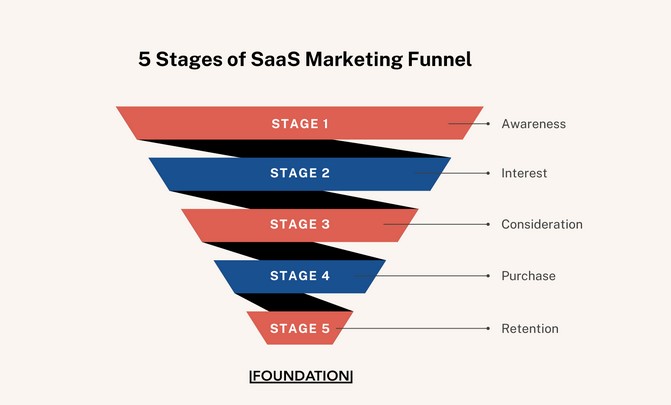
Mapping the SaaS Marketing Funnel for Growth
Source:https://foundationinc.co
Imagine spending $50,000 on a LinkedIn ad campaign that drives 10,000 visitors to your landing page, only to realize at the end of the month that you’ve closed exactly zero new customers. You didn’t have a traffic problem; you had a “leaky bucket” problem. In the world of Software as a Service, getting someone to click a button is the easy part. Getting them to trust your code enough to hand over their credit card—and keep doing it every month—is where the real battle is won.
In my decade of scaling B2B software companies, I’ve seen countless founders obsess over the “Top of the Funnel” (TOFU) while their “Bottom of the Funnel” (BOFU) is a ghost town. A successful SaaS marketing funnel isn’t a linear path; it’s an ecosystem. If you treat it like a simple megaphone, you’re going to go broke acquiring users who churn before they even finish their onboarding.
The “Fitness Journey” Analogy: Understanding the SaaS Funnel
Think of the SaaS marketing funnel like a fitness journey.
-
Awareness: This is someone seeing an ad for a new gym (they realize they need to get in shape).
-
Consideration: They read reviews of different gyms and check the equipment list (comparing your features to competitors).
-
Conversion: They sign up for a 7-day trial (the Free Trial or Freemium stage).
-
Retention: They actually show up to work out every day (Product-Led Growth).
-
Expansion: They hire a personal trainer or buy the gym’s protein powder (Upselling).
In SaaS, you don’t just want them to sign up; you want them to get “fit” using your software. If they don’t see results, they’ll cancel their membership by month two.
The TOFU: Driving Awareness and Capturing Demand
The SaaS marketing funnel begins with Awareness. In 2026, the noise is louder than ever. You aren’t just competing with direct rivals; you’re competing with every notification on your prospect’s phone.
Strategic Content and SEO
We don’t just write “blog posts” anymore; we build “authority pillars.” You want to capture users when they are searching for a solution to a problem, not just when they are looking for your specific brand.
-
Problem-Led Growth: Create content around “How to automate X” rather than “Why our software is great.”
-
LSI Keywords: Customer Acquisition Cost (CAC), Lead Magnet, Inbound Marketing, Demand Generation, Marketing Qualified Lead (MQL).
Personal Insight: The “Hidden” Intent
I’ve found that the best TOFU leads often come from “Dark Social”—podcasts, Slack communities, and word-of-mouth that doesn’t show up in your Google Analytics. Don’t be afraid to invest in brand-building that isn’t immediately “clickable.”
The MOFU: Nurturing the Consideration Phase
Once they know you exist, they enter the Middle of the Funnel (MOFU). This is the most dangerous stage because it’s where “leads go to die.”
The Trust Gap
At this stage, the prospect is asking: “Will this actually work for my specific team?” You bridge this gap with:
-
Comparison Pages: Be honest. Compare yourself to the “Big 3” in your niche. If you try to hide your competitors, you look insecure.
-
Webinars and Deep-Dives: Show the product in action. Don’t just show the UI; show the results.
-
Lead Nurturing: Use automated email sequences that provide value (templates, checklists) rather than just “Checking in!” emails.
The BOFU: Closing and Onboarding
The Bottom of the Funnel is where the Conversion happens. In SaaS, this is often the transition from a Free Trial or Freemium model to a Paid Subscriber.
-
The “Aha!” Moment: Your funnel must lead the user to the exact moment they realize the value of the software. For Slack, it was sending 2,000 messages. For Dropbox, it was saving one file. Find your “Aha!” and optimize the funnel to get the user there as fast as possible.
-
Frictionless Checkout: If your “Pro” plan requires a 20-minute sales call but your competitor has a “Buy Now” button, you’re losing 30% of your revenue to friction.
Beyond the Funnel: Retention and Expansion (The Flywheel)
Standard marketing funnels end at the sale. SaaS marketing funnels do not. Because SaaS relies on recurring revenue, the “Post-Purchase” experience is actually the most profitable part of the funnel.
Retention is the New Acquisition
If your Churn Rate is 10% monthly, you have to replace your entire customer base every year just to stay flat.
-
Customer Success: Move from reactive support to proactive success.
-
Expansion Revenue: It is 5x cheaper to sell a new feature to an existing customer than to acquire a new one.
Expert Advice: The “MQL” Trap
Tips Pro: Stop Obsessing Over MQLs.
Years ago, we lived and died by the Marketing Qualified Lead (MQL)—someone who downloaded a whitepaper. In 2026, an MQL is often just a “window shopper.” Instead, focus on Product Qualified Leads (PQLs). A PQL is someone who has actually used your software’s core feature during a trial. PQLs convert to paid users at a 3x to 5x higher rate than MQLs. Shift your marketing budget to drive product usage, not just email signups.
Scannable Metrics: What to Track at Each Stage
| Funnel Stage | Key Metric | Why It Matters |
| TOFU | Unique Visitors / Cost Per Click | Measures your “reach” and brand awareness. |
| MOFU | Lead-to-Trial Conversion % | Measures if your messaging is hitting the mark. |
| BOFU | Trial-to-Paid Conversion % | Measures the “Aha!” moment and product-market fit. |
| Post-Sale | Net Revenue Retention (NRR) | Measures if you are growing within your existing base. |
Technical Accuracy: Calculating Your Funnel Efficiency
To truly map your funnel for growth, you must understand your LTV:CAC Ratio.
-
LTV (Lifetime Value): How much a customer pays you before they cancel.
-
CAC (Customer Acquisition Cost): Total marketing and sales spend divided by new customers.
The Golden Ratio: For a SaaS business to be healthy, your LTV should be at least 3x higher than your CAC. If your ratio is 1:1, you’re a charity, not a business. If it’s 5:1, you aren’t spending enough on marketing.
Conclusion: Build a Funnel That Breathes
Mapping the SaaS marketing funnel is not a “set it and forget it” task. It requires constant tinkering. I’ve seen $100M companies nearly collapse because they stopped looking at their retention metrics, and I’ve seen “garage startups” dominate because they were obsessed with their users’ “Aha!” moment.
Don’t just drive traffic. Build a path that turns strangers into curious trialers, and trialers into lifelong advocates. In the subscription economy, the relationship is the product.
Where is your funnel currently “leaking” the most—is it getting people to sign up for the trial, or getting them to actually pay once the trial ends? Let’s troubleshoot your metrics in the comments!
SaaS Trial Conversion Tips That Turn Users into Customers
Source:https://cdn.getmidnight.com
For Software-as-a-Service (SaaS) businesses, trial periods are one of the most critical phases in the customer acquisition process. A well-executed trial allows potential users to experience the value of your software firsthand. However, getting users to convert from a free trial to a paying customer is often a challenge. In this competitive market, implementing effective SaaS trial conversion tips can significantly increase your chances of turning trial users into loyal paying customers. This article will explore proven strategies that help boost your trial-to-paid conversion rate and optimize the overall user experience.
Why Converting Trials to Customers is Crucial
The trial period serves as an essential bridge between curiosity and commitment. It’s the moment when users get to experience your SaaS offering without the pressure of a financial commitment. However, the challenge is that many users sign up for trials and never transition to paid plans, leading to high churn rates.
Understanding the importance of the trial-to-paid conversion ratio is critical. If a company doesn’t optimize the trial period and guide users toward conversion, they risk losing potential long-term customers. Increasing this conversion rate not only boosts revenue but also strengthens the long-term sustainability of your SaaS business.
Key SaaS Trial Conversion Tips to Boost Success
If you want to turn your free trial users into paying customers, there are several strategic approaches to consider. The following SaaS trial conversion tips are designed to help you maximize the potential of your trial users.
1. Offer a Seamless Onboarding Experience
One of the most critical factors in converting trial users into paying customers is a smooth onboarding process. If users struggle to understand how to get started or feel lost within the platform, they’re more likely to drop off before realizing the full value of your software.
Here’s how to ensure a seamless onboarding experience:
- Interactive Tutorials: Guide users through the most important features during the first few minutes of their trial. Interactive walkthroughs and tooltips can help them understand the core functions without feeling overwhelmed.
- In-App Support: Provide access to help within the app itself, whether through a live chat feature or a dedicated support tab. Make sure users can easily get answers to their questions.
- Personalized Setup: Tailor the onboarding process to the user’s specific needs. For example, if your software serves different industries or types of businesses, allow users to choose their relevant category early on to personalize their experience.
An intuitive onboarding process will immediately engage users and make them more likely to convert when they see the software’s value.
2. Leverage Email Automation and Reminders
The majority of users who sign up for a trial forget about it, or they don’t fully engage with the software. A robust email automation strategy can help keep trial users engaged, remind them of the trial’s value, and push them toward conversion.
Here are some key email strategies to implement during the trial period:
- Welcome Email: Immediately after signing up, send a welcoming email that explains what users can expect from the trial and outlines key features. Set the tone by providing resources like tutorials, FAQ sections, or customer testimonials.
- Engagement Emails: A few days into the trial, send follow-up emails that highlight features users haven’t yet explored. Showcase how these features could solve their pain points. For example, if your SaaS product helps with project management, offer tips on how to streamline workflow using your tools.
- Last Chance Emails: As the trial nears its end, remind users of the value they’ve experienced so far. Send a final reminder email about the benefits they’ll lose once the trial expires and offer an incentive (like a discount) to encourage them to upgrade.
Email marketing plays a vital role in nudging users through the decision-making process, keeping your product top of mind and ensuring they fully experience its capabilities.
3. Provide Incentives and Special Offers
Sometimes, users need that final push to convert. Offering special incentives or discounts during the trial period can be an effective strategy for converting users into paying customers.
Consider the following options:
- Time-Sensitive Discounts: A limited-time discount for users who upgrade before the trial expires creates a sense of urgency. For instance, you could offer 20% off for users who upgrade within the last 48 hours of their trial.
- Exclusive Features: Allow trial users to access premium features for a limited time as an added incentive to convert. When users experience the full range of benefits your software offers, they may be more likely to subscribe.
- Extended Trials: Offering an extended trial for users who show interest but aren’t quite ready to commit can be a useful tactic. For example, if users have been engaged with the product but haven’t converted, offering an extra 14 days might give them the time they need to see the full value of your service.
Providing these incentives at the right time can give users the confidence to take the plunge into a paid subscription.
Understanding Customer Behavior Through Data
Tracking and analyzing user behavior during the trial period can provide invaluable insights into where users are dropping off and what features they find most valuable. Use this data to refine your conversion strategy and better understand how to guide users toward becoming paying customers.
1. Monitor Engagement Metrics
Keep an eye on how users interact with your software during the trial. Which features are they using most? Which ones are ignored? This data can help you identify areas of the product that need improvement, and you can use this information in your follow-up emails to encourage users to try underutilized features.
2. Implement Exit Surveys
When users decide not to continue after the trial period, consider sending an exit survey to understand why they didn’t convert. The feedback will help you improve the trial experience, identify pain points, and adjust your marketing strategies for future users.
3. A/B Testing
Test different marketing tactics to see what works best for converting trial users. For instance, try different email subject lines, CTA buttons, or promotional offers to see which one generates the most conversions. Continually improving these aspects based on user data will refine your overall conversion strategy.
In conclusion, applying the right SaaS trial conversion tips can have a significant impact on your business’s success. From offering an intuitive and engaging onboarding experience to using email automation, personalized incentives, and leveraging data analytics, there are many strategies you can implement to maximize your trial-to-paid conversion rate. Each step of the user journey plays a critical role in guiding trial users to experience the full value of your product and eventually transition to a long-term paying customer. By continuously refining your approach and keeping user needs at the forefront of your marketing efforts, you can build a strong foundation for ongoing growth and success in your SaaS business.