


Mapping the SaaS Marketing Funnel for Growth
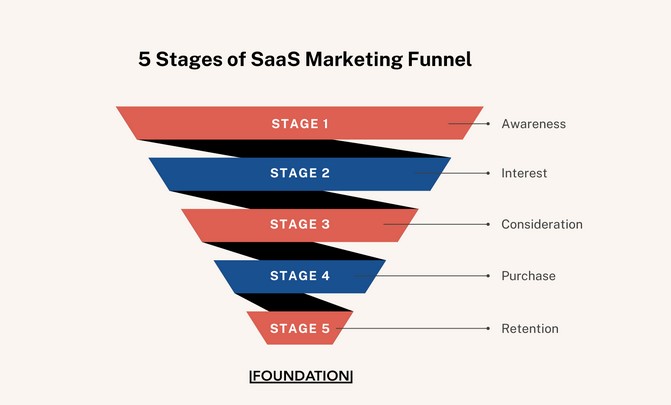
Source:https://foundationinc.co
Imagine spending $50,000 on a LinkedIn ad campaign that drives 10,000 visitors to your landing page, only to realize at the end of the month that you’ve closed exactly zero new customers. You didn’t have a traffic problem; you had a “leaky bucket” problem. In the world of Software as a Service, getting someone to click a button is the easy part. Getting them to trust your code enough to hand over their credit card—and keep doing it every month—is where the real battle is won.
In my decade of scaling B2B software companies, I’ve seen countless founders obsess over the “Top of the Funnel” (TOFU) while their “Bottom of the Funnel” (BOFU) is a ghost town. A successful SaaS marketing funnel isn’t a linear path; it’s an ecosystem. If you treat it like a simple megaphone, you’re going to go broke acquiring users who churn before they even finish their onboarding.
The “Fitness Journey” Analogy: Understanding the SaaS Funnel
Think of the SaaS marketing funnel like a fitness journey.
-
Awareness: This is someone seeing an ad for a new gym (they realize they need to get in shape).
-
Consideration: They read reviews of different gyms and check the equipment list (comparing your features to competitors).
-
Conversion: They sign up for a 7-day trial (the Free Trial or Freemium stage).
-
Retention: They actually show up to work out every day (Product-Led Growth).
-
Expansion: They hire a personal trainer or buy the gym’s protein powder (Upselling).
In SaaS, you don’t just want them to sign up; you want them to get “fit” using your software. If they don’t see results, they’ll cancel their membership by month two.
The TOFU: Driving Awareness and Capturing Demand
The SaaS marketing funnel begins with Awareness. In 2026, the noise is louder than ever. You aren’t just competing with direct rivals; you’re competing with every notification on your prospect’s phone.
Strategic Content and SEO
We don’t just write “blog posts” anymore; we build “authority pillars.” You want to capture users when they are searching for a solution to a problem, not just when they are looking for your specific brand.
-
Problem-Led Growth: Create content around “How to automate X” rather than “Why our software is great.”
-
LSI Keywords: Customer Acquisition Cost (CAC), Lead Magnet, Inbound Marketing, Demand Generation, Marketing Qualified Lead (MQL).
Personal Insight: The “Hidden” Intent
I’ve found that the best TOFU leads often come from “Dark Social”—podcasts, Slack communities, and word-of-mouth that doesn’t show up in your Google Analytics. Don’t be afraid to invest in brand-building that isn’t immediately “clickable.”
The MOFU: Nurturing the Consideration Phase
Once they know you exist, they enter the Middle of the Funnel (MOFU). This is the most dangerous stage because it’s where “leads go to die.”
The Trust Gap
At this stage, the prospect is asking: “Will this actually work for my specific team?” You bridge this gap with:
-
Comparison Pages: Be honest. Compare yourself to the “Big 3” in your niche. If you try to hide your competitors, you look insecure.
-
Webinars and Deep-Dives: Show the product in action. Don’t just show the UI; show the results.
-
Lead Nurturing: Use automated email sequences that provide value (templates, checklists) rather than just “Checking in!” emails.
The BOFU: Closing and Onboarding
The Bottom of the Funnel is where the Conversion happens. In SaaS, this is often the transition from a Free Trial or Freemium model to a Paid Subscriber.
-
The “Aha!” Moment: Your funnel must lead the user to the exact moment they realize the value of the software. For Slack, it was sending 2,000 messages. For Dropbox, it was saving one file. Find your “Aha!” and optimize the funnel to get the user there as fast as possible.
-
Frictionless Checkout: If your “Pro” plan requires a 20-minute sales call but your competitor has a “Buy Now” button, you’re losing 30% of your revenue to friction.
Beyond the Funnel: Retention and Expansion (The Flywheel)
Standard marketing funnels end at the sale. SaaS marketing funnels do not. Because SaaS relies on recurring revenue, the “Post-Purchase” experience is actually the most profitable part of the funnel.
Retention is the New Acquisition
If your Churn Rate is 10% monthly, you have to replace your entire customer base every year just to stay flat.
-
Customer Success: Move from reactive support to proactive success.
-
Expansion Revenue: It is 5x cheaper to sell a new feature to an existing customer than to acquire a new one.
Expert Advice: The “MQL” Trap
Tips Pro: Stop Obsessing Over MQLs.
Years ago, we lived and died by the Marketing Qualified Lead (MQL)—someone who downloaded a whitepaper. In 2026, an MQL is often just a “window shopper.” Instead, focus on Product Qualified Leads (PQLs). A PQL is someone who has actually used your software’s core feature during a trial. PQLs convert to paid users at a 3x to 5x higher rate than MQLs. Shift your marketing budget to drive product usage, not just email signups.
Scannable Metrics: What to Track at Each Stage
| Funnel Stage | Key Metric | Why It Matters |
| TOFU | Unique Visitors / Cost Per Click | Measures your “reach” and brand awareness. |
| MOFU | Lead-to-Trial Conversion % | Measures if your messaging is hitting the mark. |
| BOFU | Trial-to-Paid Conversion % | Measures the “Aha!” moment and product-market fit. |
| Post-Sale | Net Revenue Retention (NRR) | Measures if you are growing within your existing base. |
Technical Accuracy: Calculating Your Funnel Efficiency
To truly map your funnel for growth, you must understand your LTV:CAC Ratio.
-
LTV (Lifetime Value): How much a customer pays you before they cancel.
-
CAC (Customer Acquisition Cost): Total marketing and sales spend divided by new customers.
The Golden Ratio: For a SaaS business to be healthy, your LTV should be at least 3x higher than your CAC. If your ratio is 1:1, you’re a charity, not a business. If it’s 5:1, you aren’t spending enough on marketing.
Conclusion: Build a Funnel That Breathes
Mapping the SaaS marketing funnel is not a “set it and forget it” task. It requires constant tinkering. I’ve seen $100M companies nearly collapse because they stopped looking at their retention metrics, and I’ve seen “garage startups” dominate because they were obsessed with their users’ “Aha!” moment.
Don’t just drive traffic. Build a path that turns strangers into curious trialers, and trialers into lifelong advocates. In the subscription economy, the relationship is the product.
Where is your funnel currently “leaking” the most—is it getting people to sign up for the trial, or getting them to actually pay once the trial ends? Let’s troubleshoot your metrics in the comments!